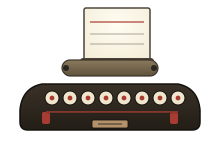
In 1896 John T. Underwood's first machine changed the entire industry: it let the typist finally *see* what they were typing. Every mainstream machine before it was a blind writer — the paper was hidden behind the platen. By moving the type bars to the front of the paper, Underwood created the visible typewriter, a design that became the global standard and survives to this day.
History
Underwood's story began with the purchase of the Wagner Typewriter Company. In 1895, ribbon and supplies dealer John T. Underwood bought the visible-typewriter patents of Franz X. Wagner, and the first Underwood appeared in 1896, reaching the market in 1897. The No.5 of 1900 became one of the most successful typewriters ever made, so complete that the name Underwood became synonymous with the typewriter itself.
In the 1920s Underwood added portables and kept dominating the standard office market; by 1927 it produced over 150,000 machines a year. During WWII the factories turned to war work. Unable to match the rise of electrics in the 1950s, Underwood was bought by Italy's Olivetti in 1959 and the brand slowly faded as Olivetti-Underwood.
What makes it special
- Visible typing — Type bars strike in front of the paper so the typist always sees the result — the source of every 20th-century typewriter design.
- Two-color ribbon — Classic red-and-black ribbon with a selector for red, black or stencil (blank) positions.
- Famous reliability — The all-metal No.5 is extremely durable; many examples still type perfectly decades later, which makes Underwood the top entry-level collectible.
Classic models
| Model | Year | Notes |
|---|---|---|
| Underwood No.1 | 1896 | First visible typewriter |
| Underwood No.5 | 1900–1932 | Best-selling classic, millions produced |
| Underwood Portable | 1919 | First Underwood portable |
| Underwood Standard / Touch-Master | 1930s–1940s | Office standard with two-tone keys |
| Underwood 315 / Script | 1950s | Late models, manual and electric |
Serial number dating (estimate)
Serial numbers give a rough production era. Precise dating needs the brand's official serial handbook.
| Period | Meaning |
|---|---|
| 1900 – 1908 | Early No.5, under ~50,000 |
| 1909 – 1919 | No.5 mature era |
| 1920 – 1932 | Late No.5 production |
| 1933 – 1945 | Standard & portable era |
| 1946 – 1959 | Post-war models before Olivetti |
Try it out
Want to try typing on a vintage machine or estimate a serial number? Both are free, in your browser.
More brands: Olivetti, Remington, Royal, Smith-Corona, Hermès, Olympia, IBM Selectric.